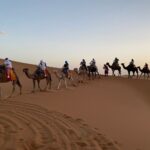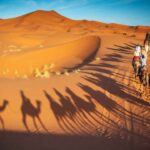
The Temperature in the Sahara Desert of Morocco is famous for big day–night swings. In the low-desert basins around Merzouga (Erg Chebbi) and M’Hamid (Erg Chigaga), summer is the hottest period: June–September often reaches 38–45°C, and nights stay warm. Winter is the coldest: December–February brings 15–22°C days, but nights can drop close to freezing. Spring is the windiest, peaking around May, when dust and haze are more common.
For comfortable travel, aim for March–May or late September–November. This guide by Touring In Morocco explains typical temperatures by month, the best times for sunrise/sunset activities, what to pack for heat or cold nights, and how to plan your visit to Merzouga, M’Hamid, and nearby desert camps.
Sahara Desert Orientation in Morocco
Erg Chebbi (Merzouga)
Erg Chebbi is the most famous Desert in Morocco, with villages like Merzouga and Hassi Labied on the dune edge. Elevation is low (around 700 m), so heat builds fast on clear days. Access is on paved roads all the way to town; a 4×4 is only needed to go into the dunes.
Typical drive times are as follows:
- Marrakech 8–9 hours via N9–N10.
- Fes 7–8 hours via N13.
- Agadir 8–10 hours via N10.
Erg Chigaga (M’Hamid)
Erg Chigaga is wilder and more remote desert, reached from M’Hamid and Tagounite south of Zagora. The last 45–60 km are off-road by 4×4 through the Hammada and dunes. Typical drive times are as follows:
- Marrakech 8–9 hours via N9 through Ouarzazate–Agdz–Zagora–M’Hamid
- Agadir 7–8 hours via N10 and Tazenakht to N9
- Fes 10–12 hours via Midelt–Errachidia–Zagora.
Elevation is very low (about 500 m), so summer afternoons get very hot.

Average Monthly Temperatures of the Sahara Desert
Average Temperature in the Sahara Desert of Merzouga (Erg Chebbi)
| Month | High (°C/°F) | Low (°C/°F) | Rain days |
|---|---|---|---|
| Jan | 16.9 / 62.4 | 3.5 / 38.3 | 1 |
| Feb | 19.3 / 66.7 | 5.8 / 42.4 | 1 |
| Mar | 24.1 / 75.4 | 10.0 / 50.0 | 1 |
| Apr | 28.5 / 83.3 | 14.2 / 57.6 | 0 |
| May | 32.5 / 90.5 | 18.3 / 64.9 | 1 |
| Jun | 37.6 / 99.7 | 22.9 / 73.2 | 0 |
| Jul | 41.4 / 106.5 | 26.4 / 79.5 | 0 |
| Aug | 40.0 / 104.0 | 25.8 / 78.4 | 0 |
| Sep | 34.9 / 94.8 | 21.4 / 70.5 | 1 |
| Oct | 28.9 / 84.0 | 16.1 / 61.0 | 1 |
| Nov | 21.7 / 71.1 | 9.3 / 48.7 | 1 |
| Dec | 17.3 / 63.1 | 4.8 / 40.6 | 1 |
Average Temperature in the Sahara Desert of Zagora (Erg Chigaga)
| Month | High (°C/°F) | Low (°C/°F) |
|---|---|---|
| Jan | 19 / 66.2 | 5 / 41.0 |
| Feb | 23 / 73.4 | 8 / 46.4 |
| Mar | 27 / 80.6 | 12 / 53.6 |
| Apr | 31 / 87.8 | 16 / 60.8 |
| May | 35 / 95.0 | 20 / 68.0 |
| Jun | 40 / 104.0 | 25 / 77.0 |
| Jul | 43 / 109.4 | 28 / 82.4 |
| Aug | 42 / 107.6 | 27 / 80.6 |
| Sep | 37 / 98.6 | 23 / 73.4 |
| Oct | 31 / 87.8 | 18 / 64.4 |
| Nov | 24 / 75.2 | 11 / 51.8 |
| Dec | 20 / 68.0 | 6 / 42.8 |
Wind trend (for planning): windier mid-March to mid-July; windiest month ≈ April (around 16 km/h avg); calmest ≈ December (around 12.5 km/h).
Safety and Comfort at a Glance
- Plan activities at sunrise and sunset; rest at midday in summer
- Drink 3–4 L water per person per day; add electrolytes in heat
- Pack layers: warm nights in winter, windbreaker in spring
- Check wind and forecast before dune trips; avoid Wadis after rain
- Wear sunglasses, hat, SPF 50; light long sleeves for sun

What Sahara Desert Temperatures Really Mean
1. Big day–night swing
Days can be warm or very hot, but winter nights drop fast. In December–February, lows near 0–5°C are possible in Merzouga and M’Hamid. Pack layers for sunrise and late evening, even if afternoons feel hot.
2. Spring winds and dust
Winds are most common from March to May. Plan dune walks and camel rides at sunrise or sunset when the air is calmer. A scarf/buff and good sunglasses help on hazy days.
3. Rare extremes
Heatwaves in summer can push temperatures well above average. Unusual rain can also cause brief flooding in low areas and dry riverbeds. Check the local forecast before you head into the dunes, and follow camp or driver advice after rain.
Sahara Desert AVG Temperatures by Season
- Winter (Dec–Feb): 15–22°C, near-freezing nights in the dunes. Clear skies and great days for hikes and photos. Pack warm layers for camp.
- Spring (Mar–May): 22–32°C with more wind and some dust days, especially April–May. Plan sunrise and sunset outings.
- Summer (Jun–Sep): 38–45°C can occur in low basins like Merzouga and M’Hamid. Do activities at dawn and dusk, rest midday, and hydrate well.
- Autumn (Oct–Nov): Cooling, stable weather. Warm days, mild nights, Ideal for overnight camps and camel treks.
Best Times to Visit the Sahara Desert of Morocco
Families/Couples: March–May and late September–November. Warm days, cooler nights, lighter wind. Good for camel rides, short hikes, and kid-friendly walks near Merzouga or M’Hamid.
Photographers: December–February. Clear air, soft winter light, long golden hours, and fewer people at the dunes. Ideal for sunrise/sunset shots and night sky sessions.
Heat-tolerant adventurers: June–September. Longer days, plan morning and evening only, rest at midday in shade or camp, carry plenty of water, and use a 4×4 support if hiking deeper into the dunes.

Read more: The best time to visit Morocco.
Packing Essentials for the Sahara Desert of Morocco
- Winter (Dec–Feb): warm jacket, beanie, gloves for night camp; light 3/2 mm thermal base layer for dawn rides; warm socks and a compact headlamp.
- Spring/Autumn (Mar–May, Sep–Nov): light layers, windbreaker, scarf/buff for dust; sunglasses, sunscreen, closed shoes for dunes.
- Summer (Jun–Sep): breathable long sleeves and trousers, wide-brim hat, high-SPF sunscreen, lip balm, electrolyte salts, 1–2 L refillable bottle; avoid dark fabrics and plan shade at midday.
Read More: What to pack for a trip to Morocco.
Planning Desert Activities by Temperature
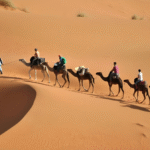
- Camel trek / dune hike: Best in winter–spring and autumn (Oct–May). In summer (Jun–Sep), go only at sunrise or sunset when temps drop—ideal around Merzouga (Erg Chebbi) and M’Hamid (Erg Chigaga).
- 4×4 / ATV (quad/buggy): All year. In summer, plan morning or evening rides only and rest at midday. Carry plenty of water and follow local guides on soft sand.
- Stargazing: Best in cooler, clear months (Nov–Mar), with long nights and steady air. Also good on moonless nights in Sep–Oct and Apr–May. Go away from the village or camp lights and pack warm layers.